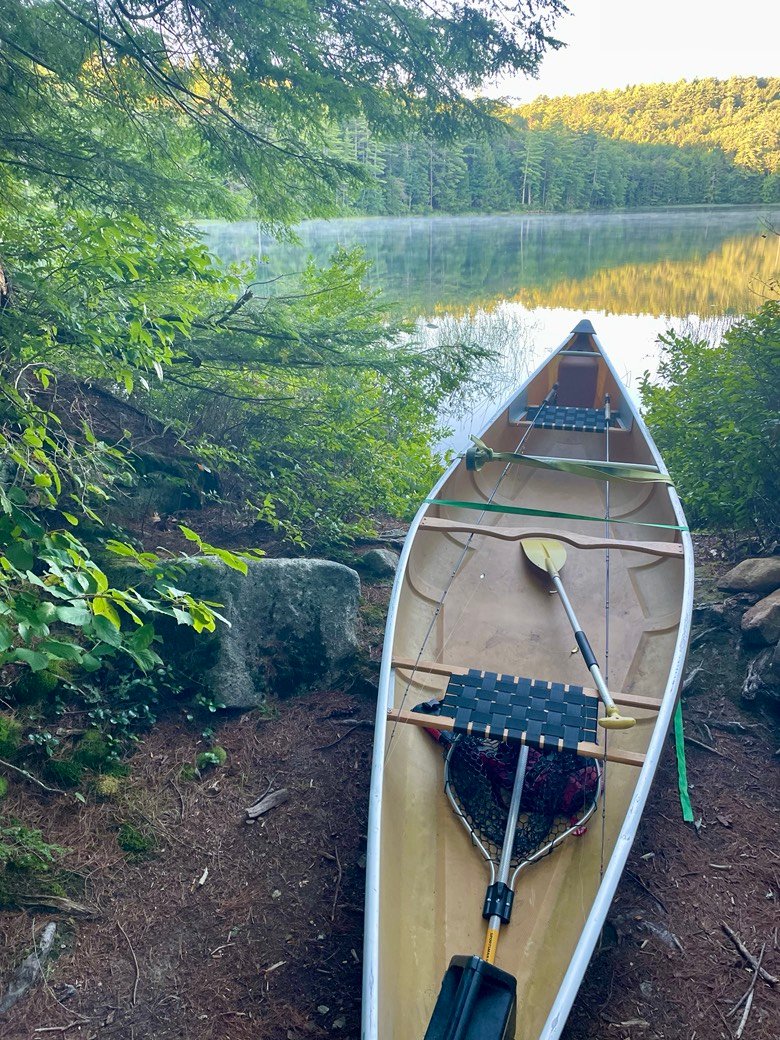
View of Basin Pond from one of the access points.
Basin Pond is a 27-acre body of water located in Fayette, Kennebec County, Maine (see The Maine Atlas and Gazetteer map 12 A2). To access this pond, drive on Sandy River Road in Fayette, turn into Shore Road, and then turn left on Basin Road. Drive on this gravel road for <1 mile until the road dead-ends in a large open space that serves as a parking area. It takes less than 10 minutes to walk from there to the pond on a wide and unobstructed trail. But beware that this trail is quite steep as it goes up one side of a knoll and down the other side. The pond has multiple access points, but does not have a boat launch and can only accommodate hand-carried craft.
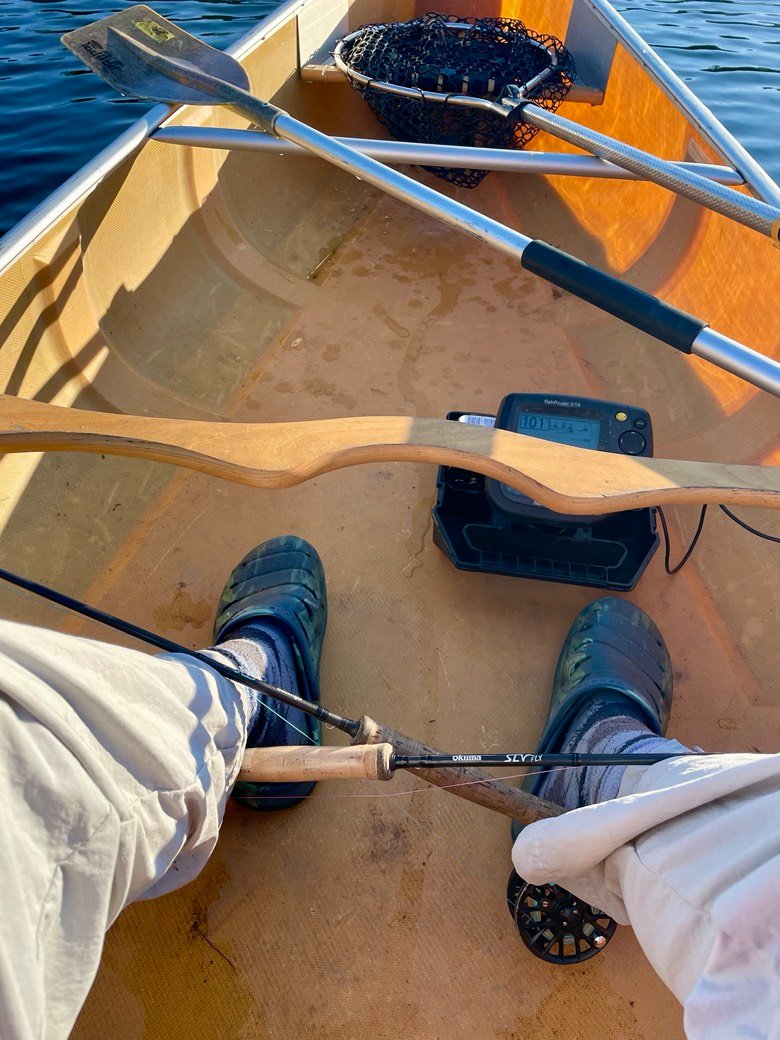
I crisscross the two lead core rods between my legs. Can you see the depth reading? That is the reason this two-rod approach works in a paddled canoe.
Basin Pond is a glacially-formed basin. It provides no visually-pleasing vistas, but projects a surprisingly “remote” vibe more commonly found further north and west, instead of 15 miles (as the crow flies) from Augusta. I found this place using my proven search method. The shoreline and riparian vegetation are intact, with a rope swing and small dock the only signs of human intrusion. The unique feature of this small pond is its incredible deepness, with a mean and maximum depth of 42 ft. and 106 ft., respectively! That is out of all proportion to its tiny size… Lacking an inlet, it gets its water mainly from submerged springs. As a result, the surface water is incredibly clear and translucent. The pond is managed as a splake fishery (a splake is a hybrid species obtained by crossing a brook trout with a lake trout). It is stocked with 50 to 100 juvenile splake, but only once every three years. That unusual schedule can only mean one thing: the State aims to maintain a small splake population to promote fast growth, but without the risk of depleting the limited local forage base, which includes rainbow smelt. Hence, I expect slow action this morning, but with the potential for a bigger-than-normal fish. Click here for a depth map and (old) fisheries information. The fishing rules are strict in order to protect this fishery: the general fishing laws for the South zone apply, except that: a) ice-fishing is forbidden, b) only artificial lures are allowed, c) only one keeper brook trout may exceed 14 inches (note: brook trout are occasionally stocked, together with the splake), and d) the pond is open to fishing from October 1 to November 30 using artificial lures only and all trout must be released. Click here for more pond-specific regulations. I went to lakesofmaine.org to obtain water quality data and determine the depth of the thermocline and its oxygen status. Unfortunately, the site was down. I gleaned from other online documentation that the thermocline in the summer sits about 20 to 25 ft. down, and that the cold water below the thermocline is not oxygen deficient, except much closer to the deep bottom.
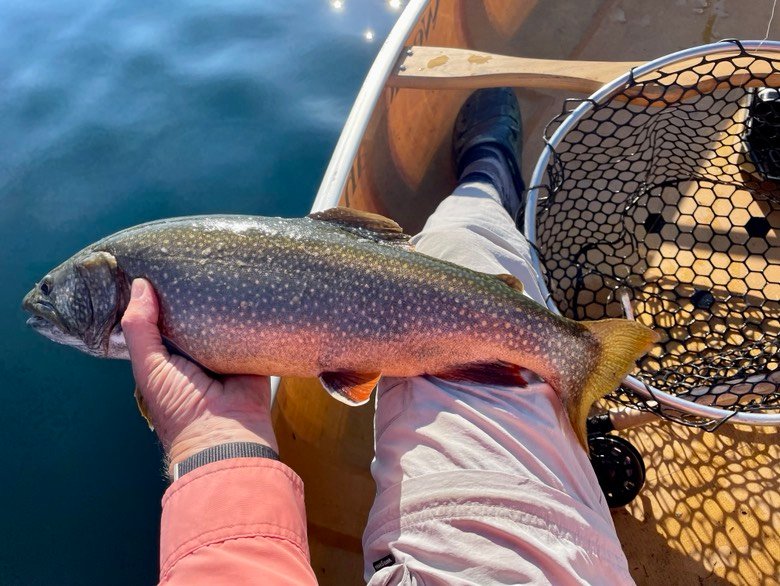
What a fighter!! This splake is also my PB!
I arrive at the Basin Pond parking area at 5:45 am. I’m running 30 minutes late, and sunrise was 5 minutes ago. I quickly walk down the path to the pond for a quick look-see, return back to the truck, and haul my gear to the shoreline using my canoe wheels. It’s a cool 59°F outside, but the forecast calls for blue sky with unlimited sunshine all today. I am trolling with two rods using lead core line. Each rod is armed with three small, trusted trout spoons, tied back to back. Using two rods means that the first deployed lead core line quickly sinks towards the bottom as I am futzing with the second line, while also trying to paddle to keep the canoe moving. But I get away with it here because of the enormous depth of the pond. I crisscross the two rods between my legs, with the two lines trolling on either side of the canoe. The advantage of using two rods is that I fish at two different depths, while trying out six different lures at the same time to determine which one is most attractive to the fish below. I deploy the lures on my left 3.5 colors down (~18 to 20 ft. down), and the ones on my right 4.5 colors down (~23 to 25 ft. down). I feel comfortable that I am targeting the thermocline because my portable depth finder constantly pings fish at that depth interval.
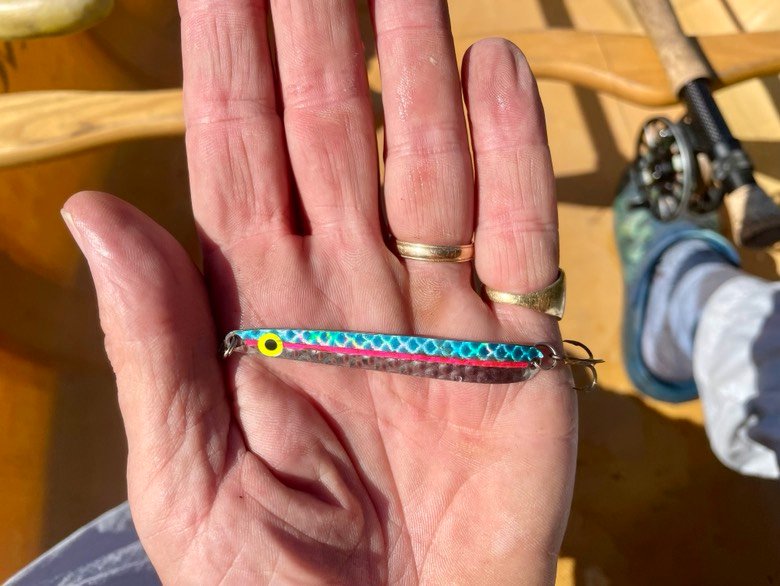
This humble DB Smelt fooled the splake into biting.
It takes about 15 minutes to make a complete circle around Basin Pond. It is so strange to see 60 ft., 80 ft., or 100 ft. reported by the depth finder in such a tiny space. Some of those depths are almost within spitting distance of the shore… I have paddled around the pond four times already, and have absolutely nothing to show for all my exertions. Following my well-established protocol, all six lures are swapped out and exchanged for larger spoons of various sizes and colors. One set of three consists of classic DB Smelt lures of different hues. I am on my third go-around in the second hour when I finally get a hard hit, on the DB Smelt rod. I immediately grab the rod, set the hook, and feel a very substantial fish at the other end. OMG, hold on! The creature takes off, quickly ripping two full colors (i.e., 60 ft.!) off the reel in one fell swoop. Hole mackerel, what did I hook? The fish struggles mightily: it takes line, I spool it back in, the fish runs off again, and so it goes. I spend five very anxious minutes slowly and carefully bringing it up to the surface, and closer to the canoe. And then, I suddenly get a glimpse of what is going on through the crystal-clear water: I hooked a big, fat splake, but by its tail!! No way; I accidentally snagged that tail when I set the hook on the hit! The reason this fish is fighting so incredibly hard is that it can run off head first (see here for another instance of the same effect). It finally gets netted, measured, photographed, and released to grow even bigger. Wow, this splake is my PB at 23 inches! I take a moment to fully absorb this incredible experience. Then, I remove the three spoons from the second rod, change them for three new DB Smelt, and redeploy all six lures 4.5 colors down, where I caught that fish. I continue paddling with renewed hope, but the fish gods decide otherwise. One more hour of going around and around yields nothing more. I call it good, having paddled non-stop for 3 hours. I only caught one fish this morning, but its size and beautiful fighting qualities made up for all the other slow fishing.
The results: I caught one fat, 23-inch splake (PB!) in 3 hours of slow fishing.
Was the information in this blog useful? I invite you to share your thoughts and opinions. Also, feel free to discuss your fishing experiences at this location.
Tight Lines, y’all.
~ ~ ~ ~ ><« ({(« º >