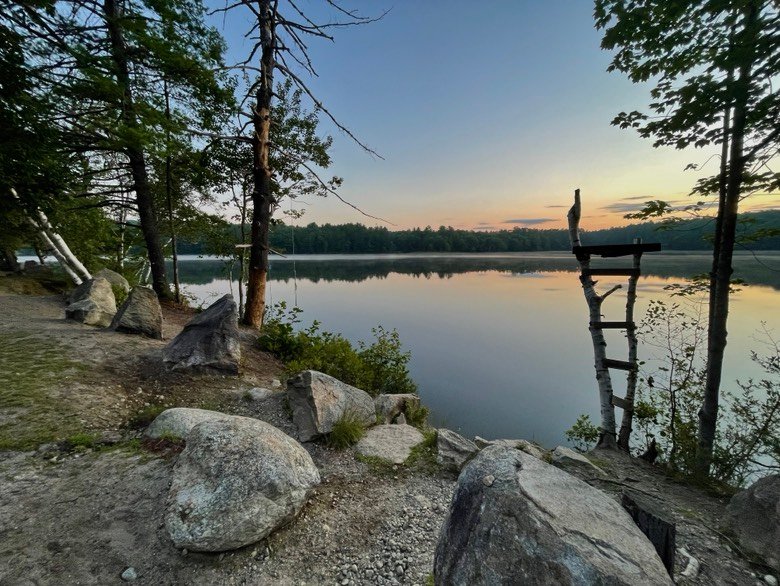
A beautiful early morning on Little Pennesseewassee Pond.
Little Pennessewassee Pond (a.k.a. Hobbs Pond) is a 96-acre body of water located in Norway, Oxford County, Maine (see The Maine Atlas and Gazetteer map 10 D5). To access this pond, drive west on Route 118 (Waterford Road) from Norway. This road eventually runs parallel to the entire southern shore of the pond. The public access point is by a picnic pergola, about halfway along that shore. Plenty of parking space is available. Note that only hand-carried craft can be put in the water because the pond lacks a trailerable launch. In addition, the shore by the access point has a 2-foot vertical drop and is located next to deep water. These conditions make it nearly impossible to safely enter into a canoe or kayak from this location. Instead, I carried my canoe to a shallow spot along the shoreline, passed the pergola and down a short, wooded trail.
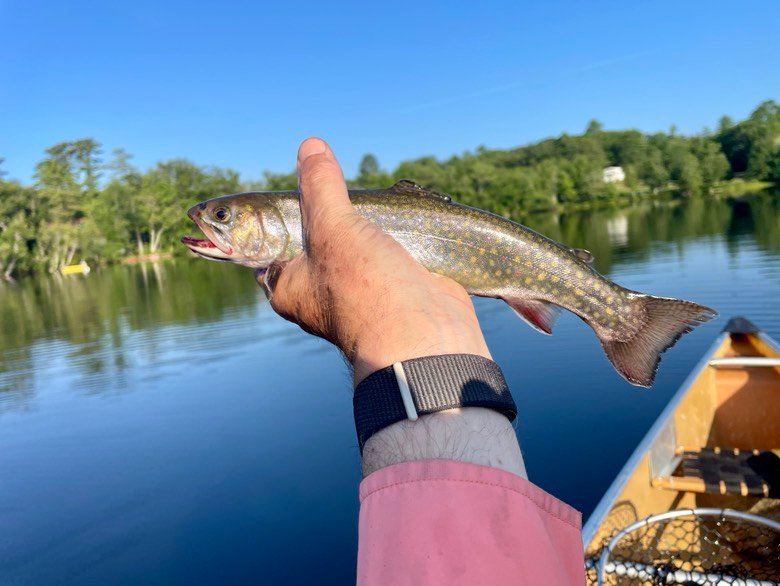
Agreed. It’s not much of a fish but it shows that the program works.
Little Pennessewassee Pond is a well-developed lake embedded in a beautiful region of southern Oxford County. It is the smaller sibling of much larger Pennessewassee Lake. I found this pond using my proven search strategy. Two specific features attract me to it: a) the pond is stocked annually with up to 12 brook trout per acre, and 1 brown trout per acre (note: the brown trout stocking explicitly means that the lake supports year-over-year trout survival and growth), and b) even though the pond is open to ice fishing (= increased winter take), its lack of a trailerable boat launch – and prohibition on using motorboats with engines over 10 horsepower – greatly limits the open-water take in spring, summer, and fall. I suspect that enough of the trout stocked in previous years, especially the more numerous brook trout, survive and grow to an attractive size. Click here for the full fishing rules. The pond has a mean and maximum depth of 17 ft. and 31 ft., respectively, making it relatively deep for its size. Click here for a depth map and (dated) fisheries information. While preparing for this trip, I checked the available water quality data provided in lakesofmaine.org to determine the presence and depth of a thermocline, and its temperature and dissolved oxygen status. A review of the available water quality data for late July-early August shows the presence of a strong thermocline located between 14 ft. and 20 ft. deep. Over that narrow, 6-foot depth interval, the water temperature drops by an amazing15+°F! The thermocline is also fully oxygenated, whereas the water below it is plenty cold but lacks oxygen. Those conditions only mean one thing: all the trout in this pond are forced to spend the entire summer stuck in that cool, oxygen-rich thermocline where they are easier to target. I specifically seek lakes with these conditions to support my summer trolling habits because the trout are “concentrated” in a narrow, well-defined band of water. It takes much of the guesswork out of the catch equation! I print out the depth map for this pond and outline the 20-foot depth contour to give me an idea of where I should focus my fishing efforts. It shows that much of the pond, except for the immediate shoreline, will serve as my hunting grounds this morning.
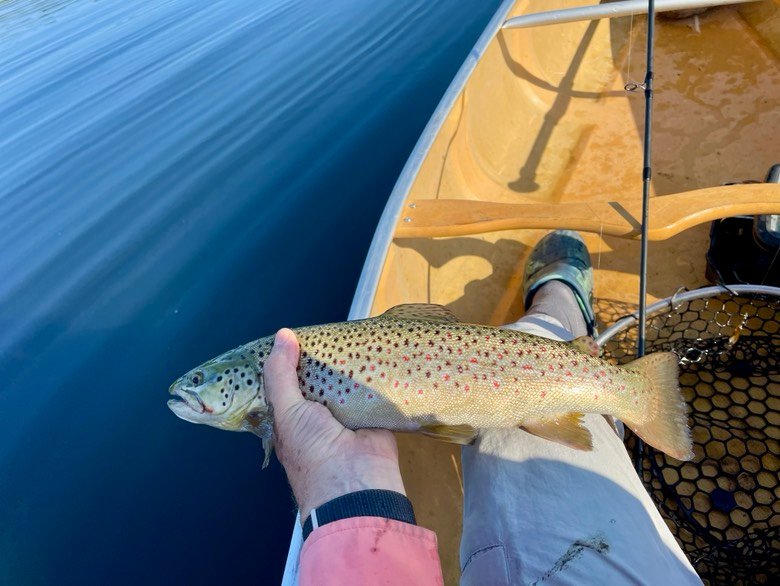
This brown trout made it all worth the effort!
I arrive at the access point of Little Pennessewassee Pond at 5:25 am. Sunrise occurs at 5:35 am. The air temperature is 62°F and forecast to rise into the mid-80’s later this afternoon. The sky is cloudless, and it is wind still. The surface water temperature is a relatively cool 74°F. I am excited to fish the “Golden Hour”, i.e., from 30 minutes before sunrise up to an hour after sunrise when the trout are actively feeding in early morning, and light conditions are low. I am trolling with lead core line from my canoe. I tie three small Mooselook Wobbler smelt-imitating spoons back-to-back, even though the pond does not have rainbow smelt. Those lures have worked well for me catching trout in ponds that lack rainbow smelt (click here and here for examples). I paddle out over 20+ ft. of water, and deploy my lures midway in the thermocline, i.e., 16-18 ft below the surface, or three colors down. It takes about 30 minutes to paddle one full circle around the pond. I have done two full circles, the sun is rising above the horizon, and I have yet to elicit a single hit. Even though I like and trust my Wobbler spoons, they are unceremoniously swapped out for three other small trout spoons. This is a key point: change the lures if they don’t work!! It makes no sense to troll for hours with the same lures if they are not attractive to our customers below. I get a hit – but no hookup – about 15 minutes later on the new lures, which raises my hopes.
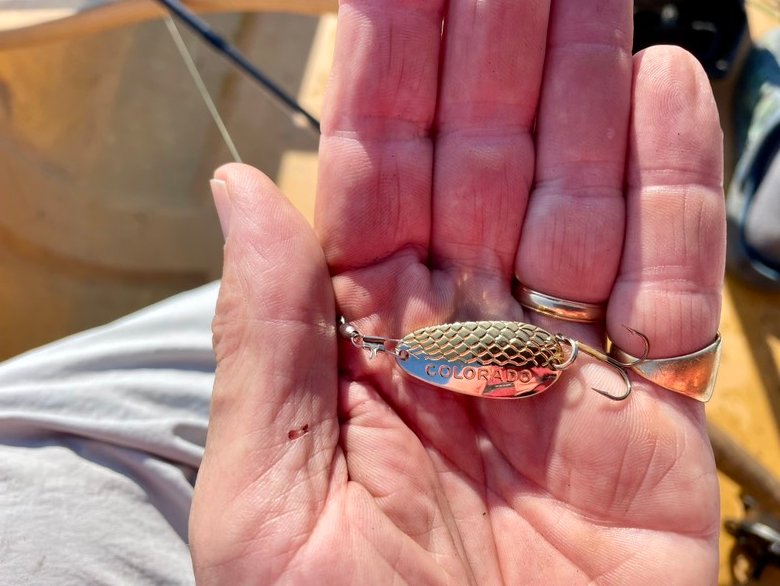
The magic lure this morning: a small 1/6 ounce bronze and silver Colorado trolling spoon.
By now, the sun is quickly rising into the blue sky above, flooding Little Pennessewassee Pond with its harsh light. The Golden Hour is truly over, and it did not produce for me this morning. I finally get a hookup close to two hours after I started trolling. None too soon!! I caught a little brook trout. It is not much of a fish, but enough of a signal to keep me trolling with the same set of lures, and to give me renewed hope. I also notice that the brookie grabbed the second of the three lures, instead of the last lure. That is an important signal, because 85% of the catches when trolling with multiple lures occur on the third – straggler – lure. I replace it with one that is identical to the second lure, and continue paddling. I get a hard hit and hookup about 20 minutes later. OMG, that one is no little brookie!! The fish takes a looong run, ripping lead core line off my reel. This is so much fun! We tussle back and forth, and I carefully cajole the creature to the surface. It turns out to be a healthy 18 inch brown trout which got fooled by that new third lure. Way to go! I caught these two fish along the shore parallel to Route 118, so I decide to focus my remaining time on that shoreline. Unfortunately, 25 more minutes of paddling up and down yields no further results. I have been at it for over 3 hours and decide to call it good. The fishing was slow this morning. I thought I would catch more – and larger – brook trout, but instead caught a nice brown trout. It paid off to stay flexible, acquire site-specific knowledge, fish the correct depth, and seek the right lure. I leave a happy angler.
The results: I caught one small brook trout and an 18-inch brown trout in 3 hours of slow fishing.
Was the information in this blog useful? I invite you to share your thoughts and opinions. Also, feel free to discuss your fishing experiences at this location.
Tight Lines, y’all.
~ ~ ~ ~ ><« ({(« º >