May 25, 2026
Location and Public Access to Pierce Pond
Where is Pierce Pond Located?
Pierce Pond is a 1,650-acre body of water located in Pierce Pond Township, Somerset County, Maine, to the east of Flagstaff Lake (see The Maine Atlas and Gazetteer map 30 A2). The goal today is fishing for salmon on Pierce Pond.
Access and Boat Launch
I access Pierce Pond via Cobbs Camp Road (a rough and narrow – but drivable – gravel road) located off Carrying Place Road (a wide logging road) which splits off from Long Falls Dam Road.
Beware that Cobbs Camp Road is gated and only open during daylight hours. Passage is free for guests staying at Cobb’s Pierce Pond Camps; day users pay a small user’s fee to park and launch their boat at the dock in Lindsay Cove.
Anglers can access the water for free at the northern tip of the lake via a rough boat launch.
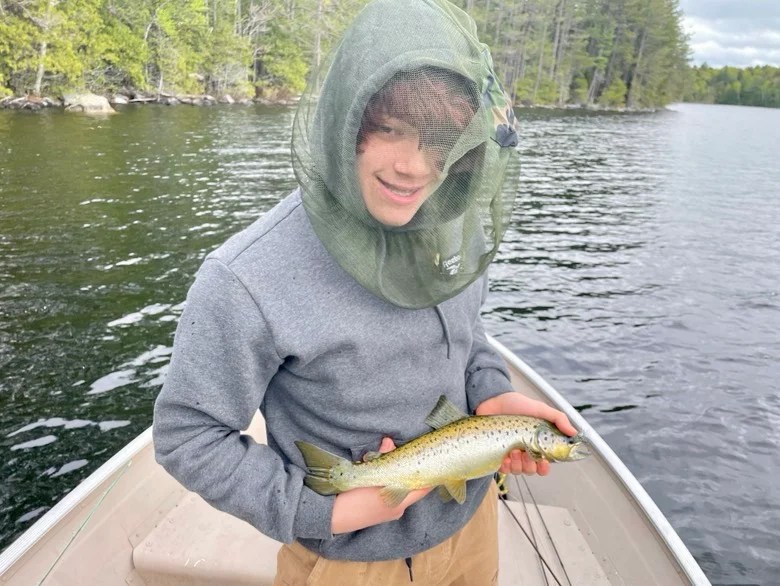
This first landlocked salmon does not appear substantial on this picture but gave Antony a splendid fight.
Pierce Pond Habitat Characteristics, Mayfly Hatches, Stocking, and Fishing Rules
Long-Term Visitors to Pierce Pond
My son Joel, his two sons, a nephew, and I are renting a cabin at Cobbs Pierce Pond Camps over the extended Memorial Day weekend. Three generations of us have been trekking to this special place for several decades to fly fish the tremendous mayfly hatches that occur on Pierce Pond in late May.
Pierce Pond Mayfly Hatches
The lake consists of three interconnected basins called Lower Pond, Middle Pond, and Upper Pond. The may fly hatching typically starts in Upper Pond because that area warms up first in the spring, and then gradually works its way down through Middle and Lower Ponds as the water continues to heat up further downgradient.
My nephew Salvy and I camped for four days on an island in Upper Pond last week hoping to hit the hatch up there. But the mayflies were mostly inactive because of overcast skies and brutally windy days. The hatches have also become noticeably less predictable across the lake over the years, which makes timing such events more of a hit-and-miss situation.
Pierce Pond Native Brookies and Stocked Salmon
Our scaly targets are brook trout and landlocked salmon. All the brookies are native (i.e., self-reproducing and non-stocked) and reach attractive sizes: hard-fighting bullies measuring 18 to 20 inches are not uncommon. The landlocked salmon reproduce in several local tributaries that enter the lake, but their population is further enhanced by sparse annual stocking.
Pierce Pond Fishing Rules
The general fishing laws for the North Zone apply at this location, except that a) the lake opens for spring fishing on May 1, b) only artificial lures are allowed, and c) the daily bag limit for brook trout is two fish, with a minimum length of 10 inches and only one keeper can exceed 12 inches. Click here for a depth map and additional fisheries information.
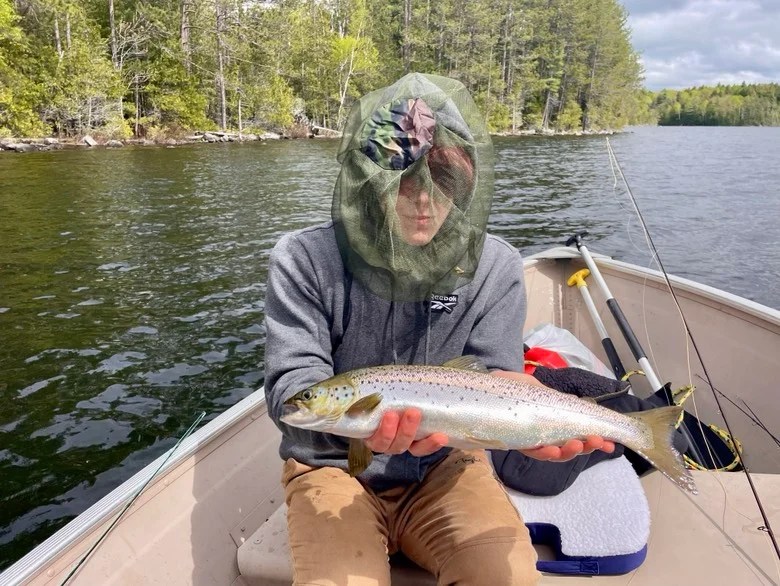
This second fish is Antony’s PB!!
Fly Fishing for Salmon on Pierce Pond
My 15-year-old grandson Antony and I are spending the afternoon together fishing Pierce Pond. The weather since yesterday has been harsh: windy, rainy, and cold. The rain stopped, but the sky remains overcast and a stiff breeze is still blowing in the wake of the departing low pressure. Those conditions are not conducive to mayfly hatching, and Antony does not want to troll because it bores him.
The Plan for Catching Salmon on Pierce Pond
Our plan is to find wind shadows in coves and protected shorelines in Lower Pond, and fly fish shallow rock piles for brook trout and landlocked salmon using wooly buggers, mayfly emergers, and small streamer flies. We find a quiet spot away from the wind, anchor, and cast out our offerings for 15-20 minutes, before the shifting wind chases us away, or we move to the next location due to a lack of action.
This frustrating game has lasted for 1.5 hours and yields absolutely nothing. We also have not seen a single fly, any hatching, or surface feeding. It is clear that our current approach is not working and that we need to change tactics to avoid getting skunked.
In desperation, I tell Antony that we need to troll close to the shoreline using our floating fly fishing lines and small streamer flies while looking out for mayflies in the air or on the water. That way, we cover more ground and increase the odds of finding an active hatch somewhere.
I note here that trolling with a floating line allows us to stay close to shore without the risk of snagging the bottom with our lures. It is a proven technique for catching salmonids in shallow water in the spring!
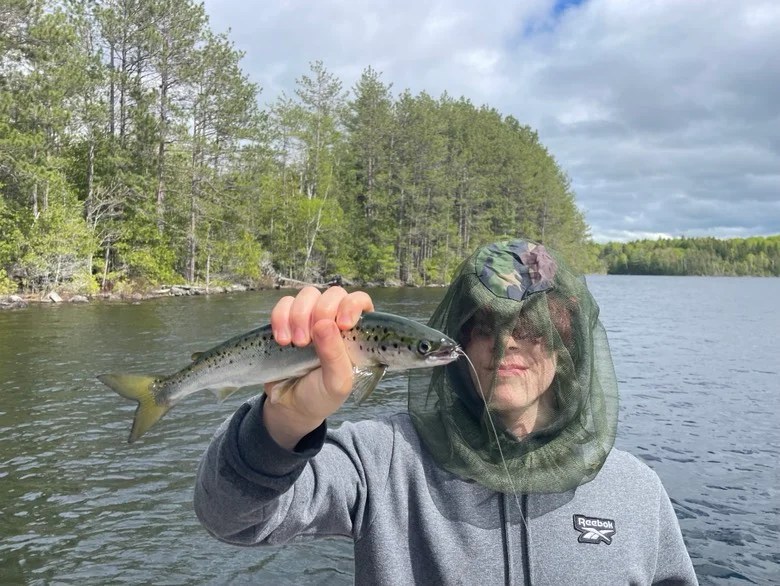
Sweet icing on Antony’s cake!
Hitting a Local Mayfly Hatch
We have been trolling for less than 30 minutes when conditions shift imperceptibly: the sun peaks from behind the clouds, the wind quiets down a bit, and we reach a stretch of shoreline in the wind shadow. And then we see it: hundreds of mayflies are sitting on the water surface or fluttering just above it. We have stumbled on an actual hatch!!
I quickly shut the engine off, gently drop the anchor, and ask Antony to stay quiet so we can look for any surface activity. In the meantime, we both replace our streamer flies with Hendrickson mayfly dun imitators. The fish gods reward us within five minutes with a forceful rise about 10 ft. in front of the boat. Yes, fish are feeding on the flies!!
Results: Fly Fishing for Salmon on Pierce Pond
Antony’s casting skills are still developing, and he cannot get his fly more than about 15-20 ft. away from the boat. Fortunately, that does not matter because an aggressive salmon grabs his fly and gets hooked. The fish fights hard and takes over half a dozen powerful runs. OMG, it does not get any better than this. Antony maneuvers the fish into the waiting net. We high-five each other with great excitement. This 17-incher was a surprisingly strong fighter.
We cast out our dry flies again, and Antony gets another hit and hookup less than 10 minutes later. Whaat? This fish is bigger than the previous one but jumps out of the water instead of taking runs. Antony skillfully fights the creature and again gets it into the waiting net. More high fives and excitement follow after we measure the fish because he has caught his personal best landlocked salmon!
We stay put because the flies are still doing their thing. Lucky Antony gets a third hookup shortly thereafter, but this one is only a 14-inch salmon. Regardless, we celebrate this fish just like the two previous ones. Then, clouds suddenly hide the sun, the wind picks up and starts blowing in our direction. The hatch stops and the remaining flies quickly disperse.
The feeding is over, and we get ready to head back to the cabin. I am skunked, but putting Antony on those three fish totally makes my afternoon. I suspect that he will remember his experience of fishing for salmon on Pierce Pond for a long time to come.
The results: I got skunked but Antony caught three landlocked salmon (largest = 20 inches) in 3 hours of fishing.
Was the information in this blog useful? I invite you to share your thoughts and opinions. Also, feel free to discuss your fishing experiences at this location.
Tight Lines, y’all.
~ ~ ~ ~ ><« ({(« º >