Early-morning view of Norton Pond from the boat ramp.
September 25, 2026
Location and access to Norton Pond
Where is Norton Pond Located?
This 112-acre water body is found in Lincolnville, Waldo County, Maine (see The Maine Atlas and Gazetteer map 14 C3). My goal this morning is trolling for trout on Norton Pond.
Access and Boat Launch
The public access is at the northern end of the pond, off Main Street (Route 173), by Breezemere Park. From Route 173, turn on Norton Pond Road and then turn left into a small paved parking area after about 300 ft. The hard-top boat launch is at the end of this parking area.
However, beware that this parking cannot be used by vehicles with boat trailers. Instead, those must be left behind on a large unpaved space where Norton Pond Road connects with Main Street.

I just love the early-fall fog vibe! It adds a beautiful dimension to the experience.
Norton Pond Features, Stocking, Thermocline, Depth Profile, and Angling Rules
General Characteristics
Norton Pond is a well-developed lake located just to the north of Megunticook Lake. Even though much of the shoreline is build-up, its waters are crystal clear. However, the pond offers no particular vistas of the surrounding area.
Annual Stocking
The State stocks this pond each spring with about 1 brown trout per acre, and each fall with around 2 brook trout per acre. The brown trout stocking density is the going rate for this species. But the brook trout stocking density is low. I am not expecting too many trout sparkles this morning, particularly since the pond is open to ice fishing which greatly thins out the brookies…
The Thermocline
I am trolling in late September and therefore expect the surface water temperature to be fine for brookies and browns (it was 64°F when I measured it).
However, I want to place my lures close to the thermocline. I check its location using water quality data published by lakesofmaine.org. The information for mid-to-late September is contradictory. Some years, the thermocline occurs 20 to 26 ft. down, whereas in others it is found much shallower, only 13 ft. to 20 ft. deep.
Regardless of the depth of the thermocline, the oxygen levels 16 ft. down are borderline for trout most years. However, those levels are much too low 20 ft. down. Thus, my trolling depth will be from 13 ft. to 16 ft. below the surface.
Depth Profile
Norton Pond is deep given its relatively small size. It has a mean and maximum depth of 28 ft. and 55 ft., respectively. Click here for a depth map and (ancient) fisheries information.
Before leaving home, I printed out the depth map and circled the 20-ft. contour depth. That way, I waste no time figuring out where to troll after arriving in the morning.
Fishing Regulations for Trolling for Trout on Norton Pond
Norton Pond can be fished in September under the general fishing laws applicable to the South Zone. Click here for the laws and rules applicable to this pond.
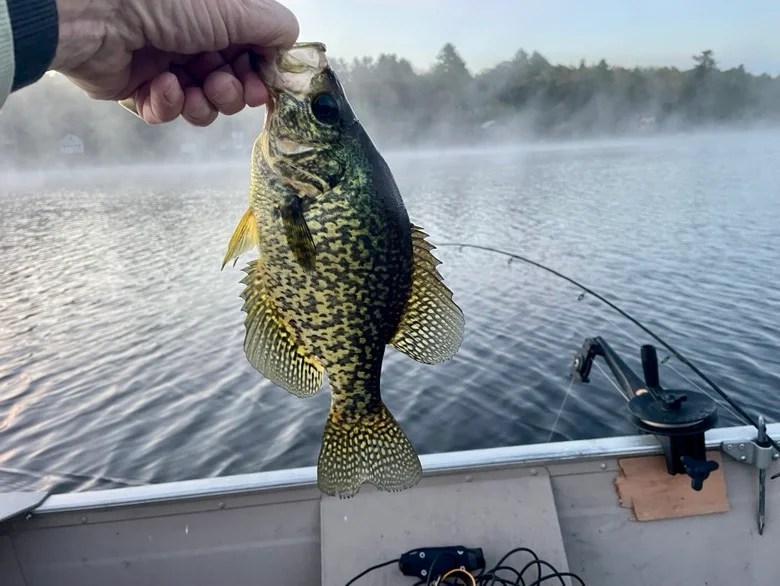
I really don’t care to catch crappies…
Trolling for trout on Norton Pond
Arrival and Conditions
I reach the boat ramp at 5:45 am, determined to fish the Golden Hour. That is the early-morning period when trout are actively chasing their breakfast under low-light conditions. It lasts from 30 minutes before sunrise (which occurs at 6:26 am today) until about one hour after sunrise.
It is cool (51°F), wind still, and quite foggy. I love the late-summer fog vibe. It occurs when the water temperature exceeds the air temperature, causing the lake evaporations to condense into fog. The air temperature will rise into the high 60’s later today under a bright blue sky.
Technique for trolling for trout on Norton Pond
I use my usual trolling setup. One is a spinning rod with three trout spoons tied back-to-back and placed 15 ft. down with a portable downrigger. The other is an 8-weight fly rod with lead core line and fishing with three other trout spoons placed 13 ft. down (about 2 and a half colors).
Hence, two rods fish three lures each at two different depths. This setup increases the odds of hooking fish! Also, I always place the spinning rod lures below the lead core line lures to minimize line entanglements.
The third (= last) lure is the “straggler”. The first two lures are connected with 1 foot of line, but the third lure is tied to the second one with 3 feet of line. Hence, it simulates a bait fish unable to keep up with its colleagues ahead. As a result, 85% of hookups occur on that straggler lure.
Results of Trolling for Trout on Norton Pond
I am excited to start trolling at 6 am, well before sunrise. I get a hit and a hook up within 10 minutes on my lead core line. Great, but it is nothing big. In fact, the fish quickly reaches the surface and then “surfs” towards the boat as I reel it in. Ugh, it’s a freaken’ crappy. I profoundly dislike catching these fish.
Over the next hour, I hook – and surf – three more of these pesky pests. But, this pattern shows that the fish on Norton Pond are chasing bait down below this morning. Hopefully, that also includes trout…
Time to Swap out the Lures
My spinning rod on the down rigger has not produced a single bite after an hour. Hence, I swap out the three old spoons for three other ones.
I also remove the three spoons on the lead core line that have only caught crappies. They are replaced with three different one-hook streamer flies tied back-to-back. This step is part of my repertoire: fish with a set of lures for one hour, but swap them out if they do not produce!
.
I am glad to see that the entire eastern shoreline remains deep in the shadows well past 8 am. I therefore focus all my trolling efforts along that shoreline.
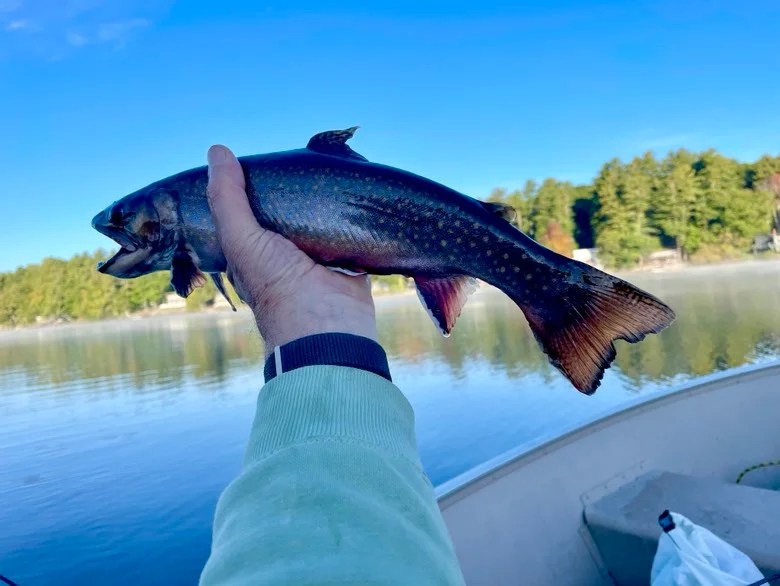
I am glad to have coaxed this nice brookie out of Norton Pond this morning.
Action on the streamer flies while trolling for trout on Norton Pond
I finally get a hookup on the lead core line that feels more than a crappy. That fish stays low and refuses to come up. Yes, I think I caught a trout! I slowly bring the creature to the surface, letting it take as much line as it requests.
The white contours of its fins are visible as the fish circles the boat. Great, it’s a brook trout. It measures 15.5 inches and is released to keep on growing.
However, that trout grabbed the top fly, which is unusual. It shows that this lure was very attractive, for whatever reason. So, I replace the “straggler” lure with an identical copy of the first fly, and continue trolling.
No more than 10 minutes later, the lead core line receives a massive hit, but I miss the hookup. Holy sh*t, that felt like a big brown trout!! But, I will never know…
A Pretend big fish…
It is close to quittin’ time. I get a final hit on the streamer flies, set the hook, and feel substantial resistance. Oooh, this sounds like a serious catch. I struggle with the fish, which is putting a serious bend in my fly rod. It refuses to come to the surface. That excludes a crappy. I continue reeling in my big catch until I see … a darn crappy.
Are you kidding me? And then I understand what is going on. I hooked the fish in one of its bottom fins! Hence, I have been reeling it in sideways, which it why it felt like a much bigger catch.
I get a frustrated chuckle out of this silly situation. But it is time to go home. I enjoyed my time on the water and had the whole place all to myself. That is just the way I like it.
The outcome of trolling for trout on Norton Pond: I caught one 15.5 inch brook trout in 3 hours of slooow fishing, plus four crappies.
Was the information in this blog useful? I invite you to share your thoughts and opinions. Also, feel free to discuss your fishing experiences at this location.
Tight Lines, y’all.