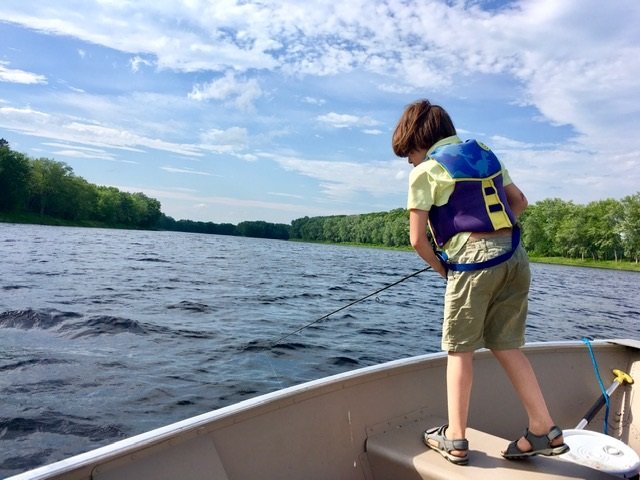
I feel so alive when contemplating a view such as this one!
August 7, 2023
Location and Access to Little Sebago Lake
Where is Little Sebago Lake Located?
This1,898-acre water body is found in Windham and Gray, Cumberland County, Maine (see The Maine Atlas and Gazetteer map 5 C2). My goal this morning is trolling for trout on Little Sebago Lake.
Access and Boat Launch
To reach the public boat launch, drive north through downtown Windham on Route 302 (Roosevelt Trail) towards Raymond. Then, turn right on Anglers Way at the light by Bob’s Seafood restaurant, drive past Pettingill Pond, and just follow the blue boat launch signs. The distance between Route 302 and your destination is exactly 1.3 miles.
The hard-top boat launch is spacious and offers plenty of parking. It also provides a convenient porta potty during the open-water season.

We still have the lake all to ourselves.
Little Sebago Lake Features, Stocking, Thermocline, Depth Profile, and Angling Rules
General Characteristics
Little Sebago Lake is a fully-developed and busy water body nestled in the lakes region of southern Maine.
The water quality conditions are such that it cannot support landlocked Atlantic salmon. But it is able to maintain year-round brown trout and rainbow trout populations.
Annual Stocking
The State sustains both species by a light annual stocking program that yields about 0.5 brown trout per acre and 0.4 rainbow trout per acre. Those are sparse numbers and I do not expect fireworks…
The Thermocline
Little Sebago Lake develops a pronounced thermocline in the summer that separates the warm, less dense surface water from the cold, more dense bottom water. The thermocline represents the layer of water in the subsurface where temperature drops most rapidly over a depth of 6 ft.
However, this lake grows too much algae due to excessive nutrient input. The algae die, sink to the bottom, and rot. That process uses all the oxygen in the cold bottom water which cannot be replaced by oxygen-rich warm surface water. The reason is that the thermocline acts like a “lid” which prevents mixing between these two water layers in the summer.
All trout need cool AND oxygenated water to survive the summer. Those two conditions exist together at only one spot in this lake, i.e., right by the thermocline. Hence, find the thermocline and you shall catch trout.
How deep is the thermocline on Little Sebago Lake?
I use measured water quality data provided by lakesofmaine.org to find the answer. Specifically, I obtain data for mid-August from sampling station #3, which is found in the bay we will be fishing.
The data vary somewhat from year-to-year, but show the presence of a strong thermocline from about 20 ft. to 26 ft. deep (some years it shifts 3 ft. higher or 3 ft. lower). The temperature drops by 10-15F over 6 ft., whereas oxygen is adequate at the top but deficient at the bottom of this layer. Based on these insights, we will place our lures 20 to 23 ft. deep, and hope for the best!
Depth Profile
Little Sebago Lake has a mean and maximum depth of 16 ft. and 52 ft., respectively. Click here for a depth map and more fisheries information.
Fishing Regulations
Angling on this lake in the summer occurs under the general fishing laws applicable to the South Zone.

We are continuously pestered by these little white perch…
Trolling for Trout on Little Sebago Lake
Arrival and Conditions
My nephew Matt flew in from away to learn the basics of fishing. He caught smallmouth bass on the Androscoggin River, wild brookies in Baxter State Park, and bass while trolling deep with lead core line.
He mentions that he would like to catch bigger trout before he leaves… I set my sights on Little Sebago Lake to try to grant him his wish.
We arrive at the boat launch in Windham at 5:45 am and push off 15 minutes later. The conditions are perrrfect: no wind, low cloud deck, and air temps in the high 60’s. The surface water temperature is a relatively-cool 73°F, reflecting the wet and rainy summer we have had so far.
Another bonus for starting early in the morning is that the bite tends to improve under low light conditions. Also, local folks are still in bed instead of jet skiing, tubing, or water skiing. Hence, we have the lake all to ourselves, at least for a while.
Technique for trolling for trout on Little Sebago Lake
We both fish with an 8-weight fly rod teamed up with lead core line. I use three DB Smelt spoons tied to one another, whereas Matt uses three small streamer flies tied to one another.
We both place our lures 4 full colors down (about 20-23 ft below the surface) and constantly “rip” the line to impart random action and movement to the lures below. We also focus all our fishing efforts on the large bay in front of the boat launch.
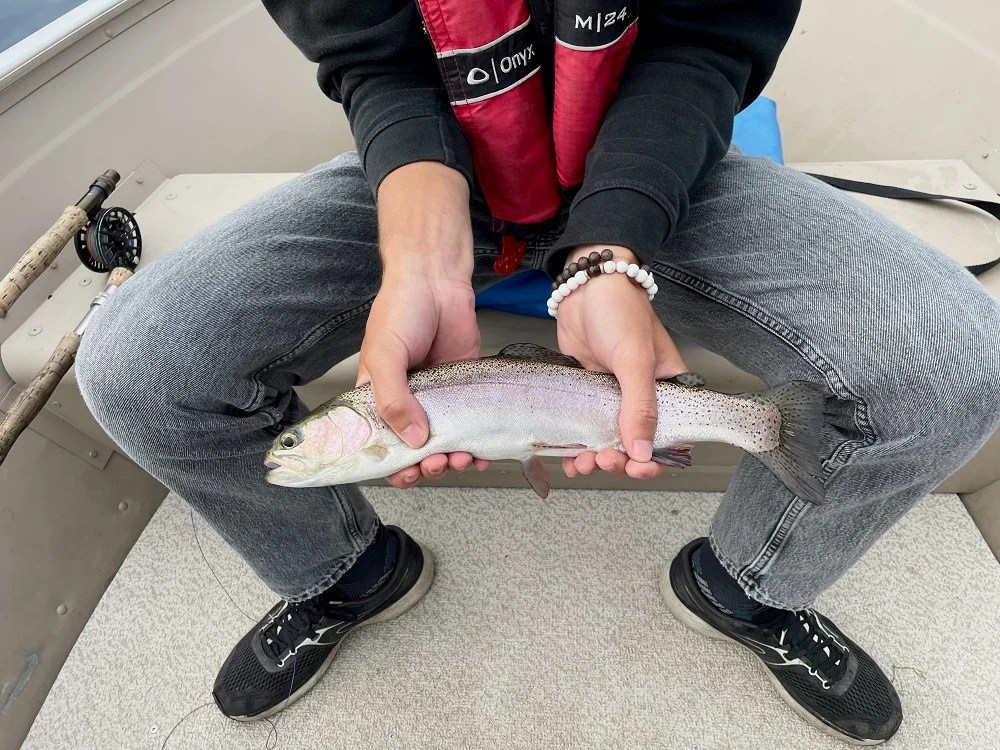
But we ultimately are successful!
Results of Trolling for Trout on Little Sebago Lake
We both get multiple hits and hookups over the next hour or so but they all consist of small white perch that are schooling and foraging near the thermocline. If anything, this pattern shows that we are not fishing TOO deep into oxygen-depleted waters, which is very reassuring…
Finally, Something Bigger than a White Perch!
We troll all around the bay but the perch seem to be everywhere. We have caught well over a dozen of the pesky little things when Matt’s rod suddenly bends over, and he starts yelping from excitement. He seems to have caught something much more substantial than a little perch!
The fish takes several strong runs while ripping line off his reel. Wow, this action is looking really promising and it seems like Matt caught a big trout. He brings the fish up slowly but steadily.
We finally understand what is going on once the creature breaches the surface… The 17-inch rainbow trout got accidentally hooked in the tail and was fighting “head first”, seeming to be much larger than what it really was. I have made that experience multiple times (click here and here for examples). It always results in a fantastic fight!
The Trout Bite is Over…
Regardless, the fish gets netted and Matt is ecstatic (and so am I!) with his catch. It gets marveled over, photographed, and released back to the water. Unfortunately, besides hooking more white perch, that is the extent of our trout catching this morning.
The lake wakes up and people are starting to buzz around in their boats. It’s time to call it good. The trout fishing was slow, but ultimately successful, showing once again the importance of targeting the proper depth when fishing for salmonids in the summer.

Matt is focused on catching another trout, but unfortunately one bow will have to do…
The results: Matt landed one 17” rainbow trout while I was skunked in 3 hours of slow fishing.
Was the information in this blog useful? I invite you to share your thoughts and opinions. Also, feel free to discuss your fishing experiences at this location.
~ ~ ~ ~ ><« ({(« º >