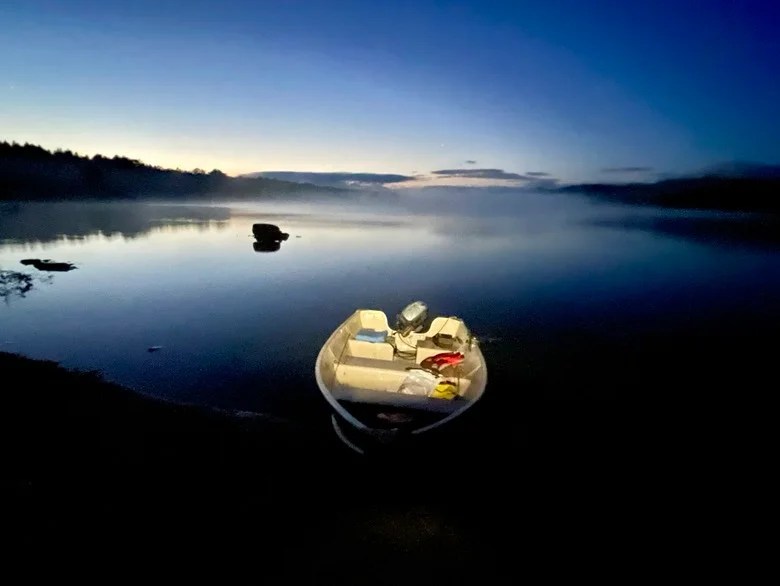
Early morning view of First Roach Pond from the boat launch. I need to shine the flashlight on the boat to make it visible, but I am on time to fish the “Golden Hour”!
GETTING THERE
First Roach Pond is a 3,320-acre body of water located in Frenchtown Township, Piscataquis County, Maine (see the Maine Atlas and Gazetteer map 41 B5). From Greenville, drive north on Lily Bay Road, which is paved, to the village of Kokadjo found at the western tip of the lake. The public access is by the dam next to the road, and is clearly marked by a sign. This dirt boat launch can accommodate big vessels. The parking area is large enough for 2 or 3 vehicles with trailers.
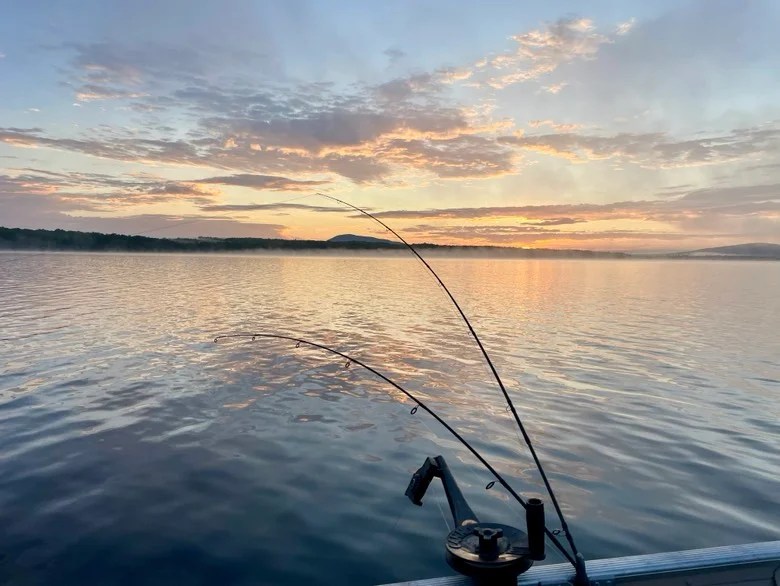
A glorious late-summer sunrise on First Roach Pond!
THINGS TO KNOW
First Roach Pond sits in a gorgeous and remote forested region to the east of Moosehead Lake. Many hills and mountains near and far surround this lightly-developed lake. I found this location using my proven search method. The State stocks this lake each year with about 1 brook trout per acre, and 1 landlocked salmon per 2 acres. These numbers are sparse, particularly for the brook trout. I am not expecting fireworks from these two species this morning…
This location is fished under the general fishing laws for the North Zone, except that a) the pond is closed to ice fishing, b) the daily bag limit on brook trout is two fish, and c) the daily bag limit on lake trout is three fish, with a minimum length of 14 inches, and with only one keeper fish allowed to exceed 18 inches. The relaxed lake trout rules intrigue me. They show that the lake has an abundance of this species, and that the State wants to thin out the population.
This water body has a mean and maximum depth of 61 ft. and 123 ft., respectively. Click here for a depth map and fisheries information. I visit lakesofmaine.org to evaluate the presence and depth of a thermocline by looking at temperatures and oxygen levels for mid-to-late August. Success means locating the thermocline because it identifies the minimum depth at which salmonids can be caught in the summer. The sparse data are inconsistent but show the presence of a weak thermocline around 30 ft. to 36 ft. below the surface, but also potentially 5 ft. deeper. The cool waters within and below this thermocline are fully oxygenated. I will need to fish over water that is 45+ ft. deep. Note that this depth occurs only about 1.5 miles to the east of the boat launch. So, it will take some motoring to get to my hunting grounds.

This first laker tells me that I placed the right lures at the right depth.
TECHNIQUE AND RESULTS
I reach the First Roach Pond boat launch at 5 am, determined to fish the “Golden Hour”, i.e., from 30 minutes before sunrise up to 1 hour after sunrise when the light levels are low and fish are actively hunting for breakfast. Sunrise this morning is at 5:50 am. In fact, it is so dark when I arrive that I have to use a flash light to get the boat ready… I put-put away 15 minutes later, and head straight out for the deeper water. Keep in mind that this lake is deceptively BIG, and deserves full respect.
I troll using a spinning rod and three DB Smelt spoons tied back-to-back and placed 40 ft. down using a downrigger, and an 8-weight fly rod with three small, smelt-imitating Mooselook spoons on lead core line placed 6 colors (about 35 ft.) below the surface. My spinning rod shakes insistently 20 minutes later. Yes, I already have a customer! I swing the rod backwards to unclip the line from the weight, and fight an angry fish. I carefully entice it to the surface, and am happy to see the deeply forked tail of a lake trout. It is no monster at 21 inches, but shows that I placed the lures at the correct depth.

I caught this second laker 70+ ft. deep based on info provided by my depth finder.
Nothing else happens over the next hour or so as I continue trolling down First Roach Pond. The sun has risen above the horizon but clouds and fog soon shade it away. That is fine with me because it keeps the light levels down. However, the lack of bites is worrying. I swap out the Mooselook spoons on the lead core line for three other DB Smelt spoons and lower the lures down to 40 ft.
My depth finder identifies bait balls surrounded by large fish at depths of 60 to 80 ft. Those fish can only be lake trout. So, I lower the downrigger weight to 80 ft. while making sure to stay over 100+ ft. of water. The spinning rod shakes hard 15 minutes later. No way, I caught something way down there! It turns out to be a 20-inch laker. I wished for something bigger, but this second fish makes my morning.
Unfortunately, that was the last action of the morning. A nasty breeze picks up from the northwest and creates white caps. I have to motor back 5+ miles to the boat launch into this wind. It is time to call it good after a slow but successful morning. The correct intel, and staying flexible, bore fruit. I leave a happy angler.
The results: I caught two lake trout (largest = 21 inches) in 3 hours of slow fishing.
Was the information in this blog useful? I invite you to share your thoughts and opinions. Also, feel free to discuss your fishing experiences at this location.
Tight Lines, y’all.
~ ~ ~ ~ ><« ({(« º >